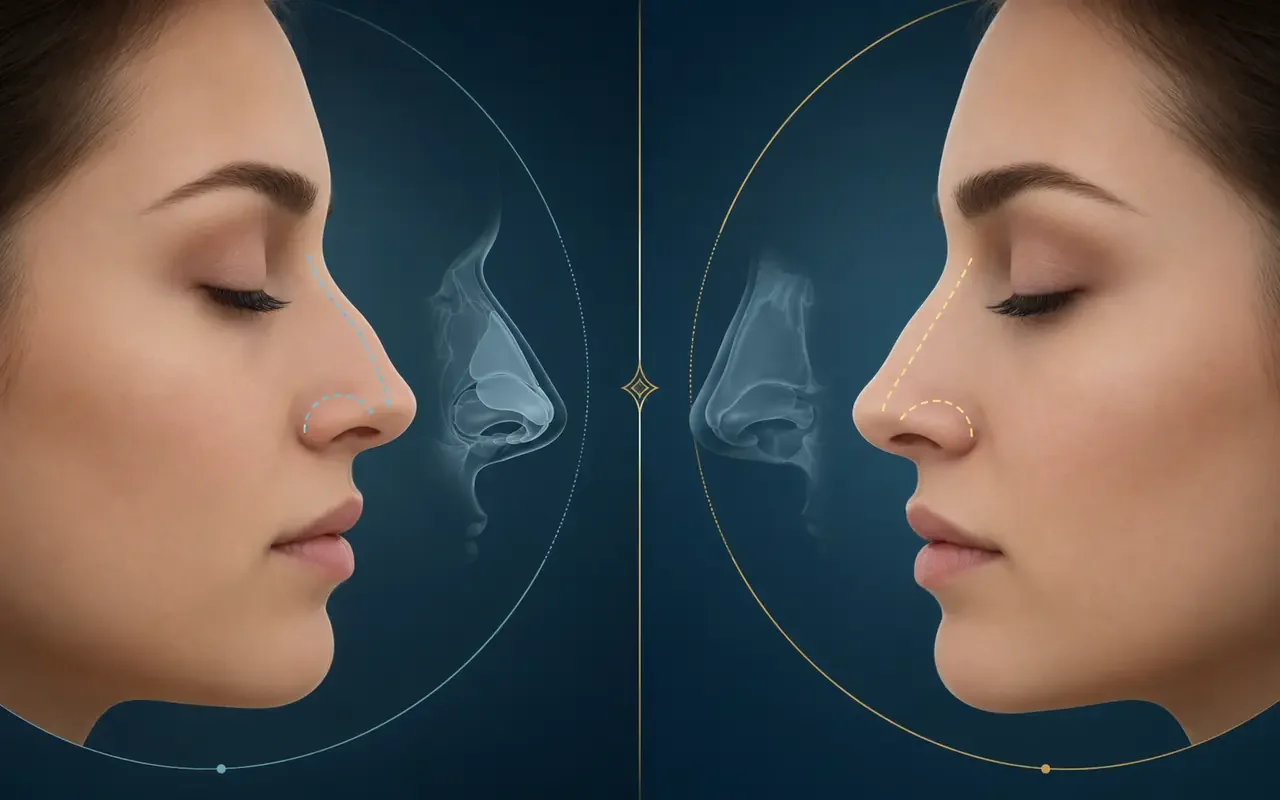

"Does a fleshy nose come back after surgery?" The answer is not the same for everyone. This term usually refers to thicker skin; the surgical plan must take into account the skin, the framework of the nose and the person's goal.[2]
Why does thick skin matter in the result of surgery?
To understand the subject, imagine the nose as a framework with a covering over it. A change in the framework under a thin covering and under a thicker covering is not necessarily equally visible from the outside. This is only an analogy for understanding the relationship between the skin and the structure beneath it, not a claim that the nose is really a building or a piece of fabric. A 2024 expert review examined the role of the skin and soft-tissue covering, longer-lasting swelling and scar tissue in planning for thick-skinned noses.[2]
"Coming back" can have several different meanings
- Swelling is still present and the tip of the nose has not become defined.
- The initial expectation was not consistent with the range of change that is possible.
- During healing, the appearance of the tissues has changed.
- There is a structural problem or an undesirable result that must be evaluated separately.
These situations cannot be considered the same from a single photo. The time that has passed, the course of the appearance and the examination are important in evaluating the concern. Research on thick skin does not make a promise of "no return for everyone" or a verdict that "no fleshy nose gets a result".[2, 3]
What has been examined in research?
In a study published in 2024, the records of 26 patients with thick skin were reviewed retrospectively. Assessment of the skin before surgery and attention to the framework of the nose were part of the treatment approach; patient satisfaction was also reported. This result does not mean a guarantee for everyone: the number of participants was limited, and the study was not a large randomized comparison between all surgical methods. Knowing the type of study helps us not to build unrealistic expectations from a hopeful headline.[3]
Why can an early judgement be misleading?
The reduction of the initial swelling and the definition of the final details do not follow a single timeline. The ASPS guide explains that the appearance of the nose changes over months and that the shape may take up to about a year to become more complete; the actual time differs from person to person. Therefore a photo from the first weeks should not be compared with the final-result photo of another person. About the right time to evaluate the result, ask the surgeon for your own follow-up plan.[4]
What expectation should we raise in the consultation session?
Instead of asking for "the smallest possible nose", divide your wish into a few clear points: the width of the tip, the prominence of the bridge, the proportion to the lip and chin, and the quality of breathing. You can bring these questions: In my nose, which feature is more related to the skin? Which change will be more clearly visible from the outside? What limitation exists? Which similar cases, in terms of skin and structure, are there? If I do not agree with the proposed plan, what other option do I have?
This list is the editorial team's suggestion for making the conversation more precise. The answers must come from your own examination. A similar nose on social media does not replace an explanation of the range of change and the limitations of your nose.
More care does not always mean more manipulation
Do not put vigorous massage, tightening the tape, injection or taking medication based on the experience of others in place of a follow-up plan. The treatment methods in the studies were for selected patients and with specialist evaluation; the name of a drug or technique in an article is not a recommendation for personal use. If you are worried about the swelling or the appearance of the nose, prepare dated photos of the progress and raise it with your treatment team.[3]
Which sign should we not postpone in the hope that swelling will subside?
Infection, breathing problems and poor healing are among the complications that must be considered in a surgical evaluation. Do not attribute a worrying change or a worsening of the condition only to "being fleshy"; contact your doctor for evaluation. The aesthetic result and breathing health must be reviewed together.[5]
So what is the answer to the question of coming back?
Thick skin increases the need for planning and realistic expectations; but by itself it is not a definitive verdict on coming back. The next step is to know the features of your own nose and to follow the course of healing, not a hasty comparison with a photo.[2, 4]
Information on the rhinoplasty service and the questions before surgery can help with preparing for the consultation.
What term is used in the official Iranian source?
In the explanation by an ear, nose and throat specialist published on Webda, the scientific evaluation relies on skin thickness, not just on the common labels "fleshy" and "bony". For you, the practical meaning of this point is that in the consultation the state of the skin and the structure of the nose should be examined; the colloquial name alone does not predict the result of surgery.[1]